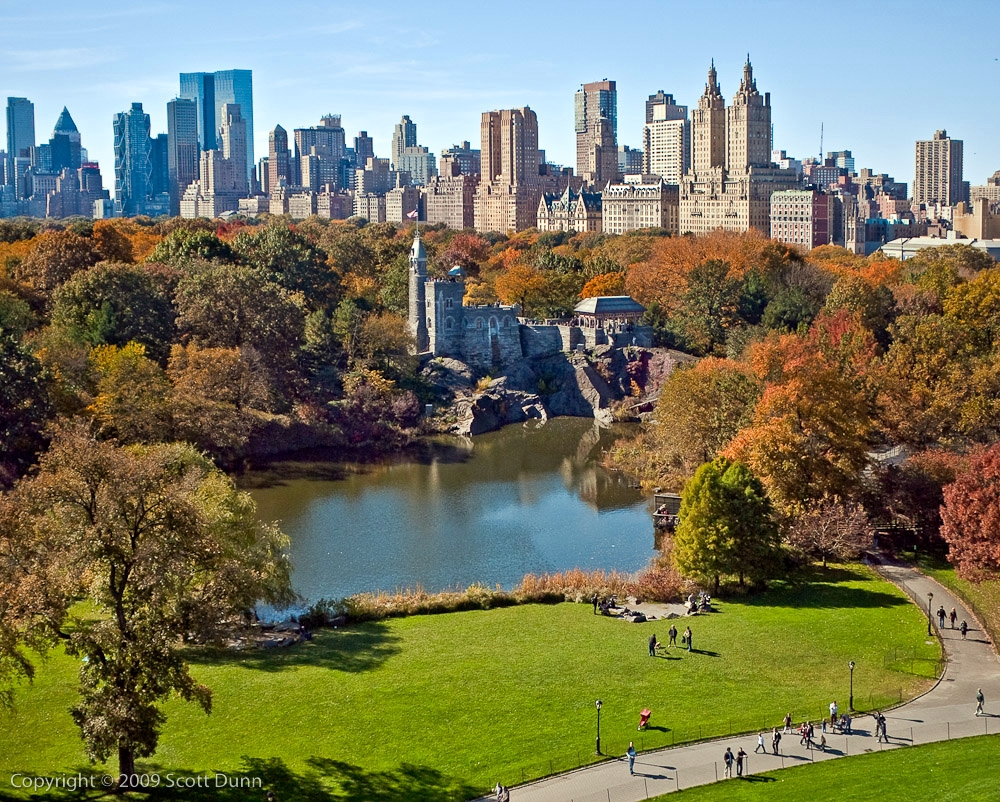
Spanning 843 acres through the heart of Manhattan,
Central Park is an oasis for millions of residents and visitors from around the
world. Its ingenious design permits seemingly endless exploration through its
constantly changing terrain, and allows you to forget that you are in the
middle of a bustling city.

Central Park was the first urban landscaped park in
the United States. The Central Park Commission, appointed in 1857, held a
landscape design contest, and chose the “Greensward Plan,” submitted by park
superintendent Frederick Law Olmsted and architect Calvert Vaux. The site of
the park was chosen because its rocky, swampy landscape was unsuitable for
private development. Their design called for roads that trans-versed the park
to be sunk well below ground level, allowing the terrain to stretch seemingly
uninterrupted. Many of the park’s features were designed in the traditional
English style, with formal promenades contrasting with sweeping meadows. Separate
paths for pedestrians, horses and carriages circulate traffic comfortably
throughout the park. Over forty unique bridges, some pf the park’s most
distinctive and beautiful architectural features, keep the paths separated.

The park stretches two and a half miles from 59th
Street to 110th Street, and a half mile from Fifth Avenue to Eighth
Avenue. The Mall and Bethesda Terrace are the main formal elements of Central
Park. Rows of American Elms line the 40-foot wide Mall, providing a cathedral –
like ceiling over the walkway. The Mall is the park’s designated area for
sculpture, with representations of figures from literature, music, and other
historic figures located in the area. The grand promenade of the Mall is a
traditional centerpiece that stands out amongst the park’s natural features. It
ends at Bethesda Terrace, the architectural heart of the park. Bethesda Terrace
overlooks Bethesda Fountain, the only sculpture commissioned in the original
design of the park.


In the winter, thousands of ice skaters converge daily at Wollman Rink.
Located at the southern end of the park, the picturesque rink is one of the
more romantic images in the park. The midtown skyscrapers have provided a
spectacular backdrop for skaters and spectators alike since the rink opened in
1950.

The Reservoir, named the Jacqueline Kennedy Onassis
Reservoir in 1994, is best known for the 1.58-mile track that surrounds it. The
106 – acre body of water no longer supplies Manhattan residents, but rather
distributes water to many of the smaller bodies of water in the northern part
of the park. Some of the sights that you can find around the Reservoir are
three elegant cast-iron pedestrian bridges, and the cherry trees, originally
given as a gift from japan in 1912. The Reservoir is located in the middle of
the park, from 85th Street to 96th Street.

There are many other features in the park to explore
and keep you entertained seemingly endlessly. Take a ride in a authentic
Venetian gondola, rent a rowboat at the Loeb Boathouse, or explore the Ramble,
a 38-acre concentration of woodland thickets, intricate rocky outcrops, and
meandering paths. It is perhaps the best spot in New York City for bird
watching and to experience nature. The many lakes, theaters, vistas and other
features carefully designated at every turn make Central Park a joy to
discover.


